|
 |
| |
West |
|
| |
[If you have not read yet the pages about the Circle and Directions, please consider doing that now, before you read this page. Those pages should ideally be read in this order: Circle, East, South.]
|
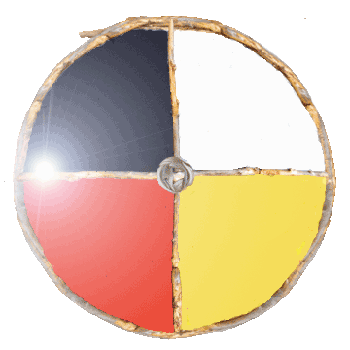
In much of North America, storms come from the west. Thunderheads tower blindingly white into skies blue as sapphire, until their bases spread into wide sheets of slate gray and black. Lightning flickers restlessly in the stillness. Then come rain and hail, strong winds, and sometimes tornadoes. The violence of thunderstorms may damage and terrify, but the rain they bring fills the rivers and makes the land bloom.
You can see why West is a place of double-edged power beyond imagining. It is a direction associated with awe and paradox -- one that reminds us that our lives depend utterly on things immeasurably larger than ourselves and far beyond our control. Whenever you reach the phase of a project or task that requires coming to terms with conflicting information or ideas, or gain the kinds of powerful understandings that come from such a struggle, you are in the West. The bases of the thunderheads so strongly associated with this direction are its color: black.
West and Tapestry Institute.
The image used for West on Tapestry's Circle is a burned tree enveloped by storm. The tree in the picture is from Sowbelly Canyon and was burned to death in the fire that swept the Canyon in 2006. The wildfire that killed this tree was part of a powerful but terrifying learning experience typical of the West.
West and Story in Tapestry's Projects.
The Circle describes a journey, which is a type of story. So, just as Tapestry's work may be explained by the Circle, it may also be explained by the story Tapestry lives out through its projects.
West marks the climax phase of any story. In our work, the climax comes after we've brought together the pieces of people's relationships to the earth and reassembled them. Because different people from different cultures, places, and times have had different experiences of the natural world, reattaching the pieces of all their experiences creates dissonance. We need all the parts to understand the whole picture because they are all part of it, but no one has personal experience of more than a few types. So understanding how to "read" the whole picture from a collection of a few parts we do understand and many parts we don't is a challenge. It means the climax stage of each of Tapestry's projects is marked by personal and community struggle that's meaningful and rewarding -- but not easy.
Genuine resolution of all the understandings expressed by all the different pieces cannot be accomplished by compromise. Understanding comes from letting the real, living thing -- the relationship we're seeking to begin with -- emerge whole from the reassembled pieces. This is the part of our work where the power of the land as our partner in the work becomes a key factor in what we do. It's the land that brings the pieces into life again, through all the individuals working on it at the time and through experiences they have on the land as they do it.
West and Ways of Knowing.
Tapestry uses the Circle to illustrate and explain the different ways that people know and learn about the natural world. Learning in the West tends to be so powerfully tumultuous that many people point to their spiritual traditions as a source of understanding when they try to explain it. We have therefore linked Spiritual Ways of Knowing to the West quadrant of the Circle.
|
|
|
|
|
|
 |
|
|